

MediPulih Klinik Doctors Strengthen Expertise Through Advanced Wound Management Training
January 19, 2026
Prevention is Your Best Defense
June 22, 2026PART I-Beyond the Taboo: Redefining Contraception
-By Dr. Sharmilah Paniselvam M.D
If you walk into a pharmacy or clinic in Malaysia as a young, unmarried woman and ask about birth control, you might brace yourself for "the look." You know the one; a subtle, heavy glance of judgment that makes you feel like you’ve walked into the wrong room.
For generations, our society has treated contraception as a topic reserved strictly for after the wedding. It is widely viewed as a tool meant only for married couples who have completed their families and want to press the "pause" button.
But that old-school script doesn’t match the modern reality we see in our medical practice. Contraception is fundamentally healthcare. It is about personal autonomy, lifestyle management, and quality of life. It’s time to move past the old taboos and talk openly about who actually benefits from modern contraception. The answers might surprise you.
1. The Jet-Setter: Managing a Demanding Career
Imagine managing a gruelling corporate schedule, pitching to clients, or navigating frequent international flights while dealing with unpredictable, heavy, or agonizingly painful periods.
For the modern career woman, a chaotic menstrual cycle isn't just an inconvenience; it’s a logistical hurdle. Contraceptives do much more than prevent pregnancy; they can lighten, stabilize, or completely pause menstruation. For women on the move, contraception acts as a lifestyle organizer, offering predictability and peace of mind across different time zones.
2. The Teenager: Protecting Dreams Before They Turn into Statistics
When society looks away from the contraception taboo, young girls pay the price. Unintended teenage pregnancy isn't a rare headline; it’s a quiet crisis right here at home.
Consider the raw data: between 2020 and 2024, a staggering 41,842 girls aged 19 and under were recorded as pregnant at Ministry of Health facilities, nearly 17,000 of whom were unmarried. The momentum hasn't stopped, with over 6,100 more teenage pregnancies documented between 2023 and early 2025 alone.
An unplanned pregnancy can instantly halt a young girl's education, altering her life’s trajectory overnight. Safe access to contraception isn't a green light for early intimacy; it is a critical protective shield. It ensures young women can stay in school, protect their health, and keep their futures firmly in their own hands
3. The Independent Woman: Embracing Lifestyle Autonomy
Success, fulfilment, and happiness no longer follow a single, outdated blueprint. Many independent women prioritize financial freedom and personal growth; choosing a lifestyle focused on goals that don't involve raising children.
Yet, society often meets this clarity with whispers and unwarranted judgment. Let’s change the narrative: reliable, long-acting contraception is the ultimate tool for personal liberty. It completely eradicates anxiety, respects their choices, and ensures their life trajectory remains fiercely and unapologetically their own to dictate.
4. The Special Needs Adolescent: Restoring Comfort
Perhaps the most overlooked and deeply moving use of contraception lies in specialized adolescent care. For young girls with severe neurodevelopmental conditions or profound physical disabilities those who rely entirely on their caregivers for basic mobility and daily activities, the arrival of a monthly period is an overwhelming, sensory-heavy nightmare.
It places an immense physical and emotional toll on both a vulnerable child who cannot manage the pain, and the exhausted caregiver struggling to maintain hygiene under such gruelling limitations. In these cases, contraception transcends birth control; it becomes an act of pure mercy. Doctors prescribe contraception for menstrual suppression, safely minimizing or halting periods entirely. This isn't about birth control, it’s about lifting a heavy caregiving burden and giving a vulnerable child a pain-free life.
The Bottom Line
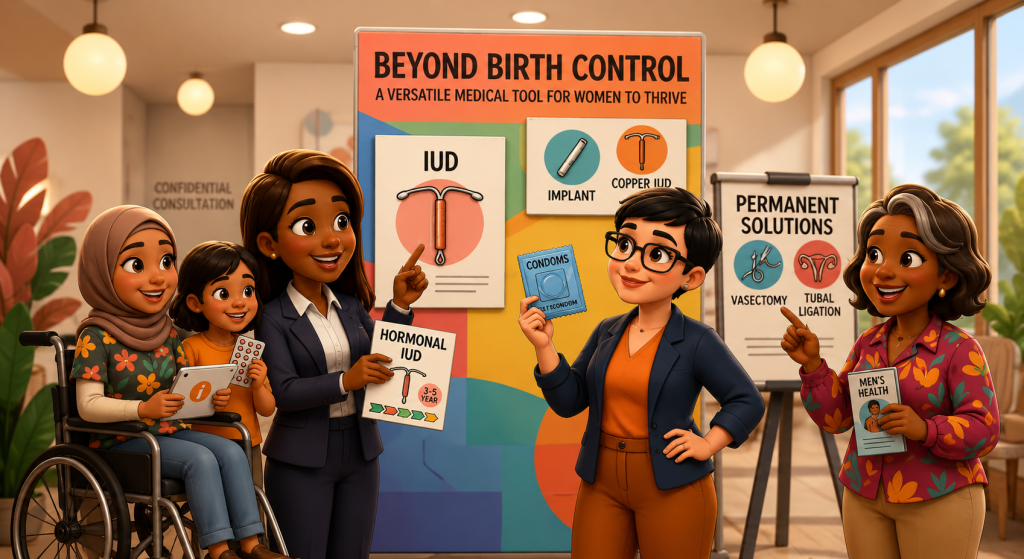
Contraception is not a taboo topic to be whispered about, nor is it a privilege exclusive to marriage. Whether it is used to protect a future, manage a hectic travel schedule, honor a personal lifestyle choice, or provide relief to a special needs child, it is a versatile medical tool designed to help women thrive. In our next article, we’re stripping away the confusing medical jargon and playing matchmaker: how to choose the right contraceptive method based on your actual, daily life.
-
References
1. Malaysian Paediatric Association. When Children Have Children. Published 9 March 2026.
2. Ministry of Health Malaysia (MOH). Statistics on pregnancies among girls aged 19 years and below recorded at government health facilities, 2020– 2024. Data cited in parliamentary replies and reported by media outlets. Available at: The Star , New Straits Time.
3. The Sun reported on Ministry of Health data regarding teenage pregnancies in Malaysia
4. American College of Obstetricians and Gynecologists. Menstrual manipulation for adolescents with physical and developmental disabilities